
Gran Recorrido 11 (GR11)
The GR11 travels across the Pyrenees over 800 km from the Atlantic Ocean to the Mediterranean
Sea and was our destination in June 2005. It had been my dream to hike the GR11 and for
Carsten a welcome possibility to find out whether we could carry on harmoniously as a
couple under long distance hiking conditions...we could and can :-)
The trail that connects the Atlantic with the Mediterranean in 47 stages,
starts at the lighthouse at Cabo Higuer in the pretty town of Hondaarríbia.
The GR11 ends after many passes, numerous valleys and two national parks
at Cap Creus its most eastern point. It crosses the Basque Country,
Arragon, Navarra, Catalonia and Andorra, the small Co-Principality so that
the hiker will hear different languages along the way. It is worth
mentioning that each Spanish province is very proud of its identity.
Until Isaba, the first 120 km, the hiker travels through hilly countryside,
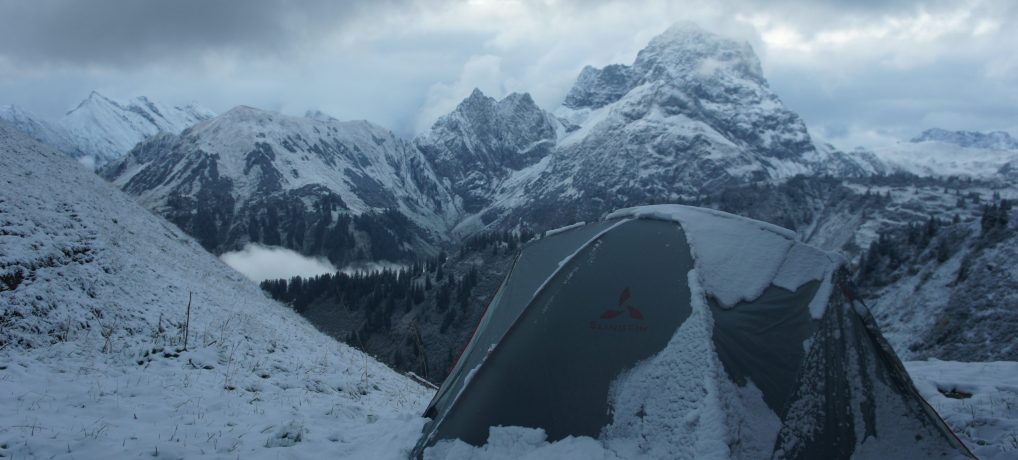
which offers over and over again views on the snow covered peaks and slopes
which he will cross on his way. From Isaba on the heights increase, the
terrain becomes partially very steep and is only recommendable for
experienced hikers. The views and the scenery though remunerate always
for the pains that one has taken so that at the end of one arduous day
one is already looking forward to the next. For photographers it is a
paradise which means that one either should take enough rolls of film
or accordingly large memory cards because in Spain they are high priced.
From Beget on, 155 km short of the destination, the mountains flatten
again and the hiker enjoys the hilly pastures and forests until he
reaches the sea after a total of 837 km, 39500 ascended and 39500
descended meters.
In the middle, mountainous section the hiker traverses many passes,
the highest with 2780 m, snow and scree fields, passes beautiful glacier
lakes and landscapes that could come directly from a fairy tale.
The Ordessa National Park with its sensational rocks reminds of the
Grand Canyon and who can spare some time has the opportunity to
climb Spain's third highest peak, Monte Perdido, 3355 m. The St. Maurici
National Park becharms the hiker with its opal green twinkling lakes
framed by coniferous forest and high peaks. The hanging valleys, each
one with a lake would have been suitable as setting for Karl May' s
Winnetou' s adventures.
The fauna excels with numerous eagles, mountain goats and marmots.
The hiker will see unexpectedly many horses with cow bells -sometimes
more sometimes less shy- even on high passes and in the valley of La
Mina shortly before the valley of Aguas Tuertas all cows of Spain
seem to have their big meeting. Foxes can be seen very seldom and
if at night something rustles in the foliage or at the food bags
it probably is a mouse maybe even one with a wisp at its tail.
The small villages along the trail like Elizondo, Ochagavía, Isaba,
Torla and Benasque, to name just a few are worth seeing. All of them
are restored and well kept in such a way that one could gain the
impression that time stands still. Each one has a supermarket,
sometimes corner shops where the hiker can resupply for the next
stages and at the same time backs up the region economically.
Overall the GR 11 is a very beautiful and at times also a demanding
trail which arouses the wish to return very soon.
Yours Alina
|
|